This is Woolfoot’s entry into the 2006 Ross Essay Contest sponsored by the American Bar Association. Lawyers were invited to submit an essay describing how life in the law has changed them. I had counted on winning, but wound up an also-ran (they did “publish” this in their weekly e-newsletter but no coin for yours truly). I liked it though, so I'm sharing
If I had been good at math, and or science, I could have been a doctor. But I was not. The only thing I remember about 10th-grade geometry is the time a classmate came to the front of the room to get a hall pass and barfed all over the one teacher in school who had a PhD. That is vivid. I can’t remember one theorem. About one week into 11th-grade chemistry, the teacher started talking about “atomic weights.” I fled. Chemistry wasn’t required for high school graduation.
Within the first few weeks of law school I learned that the capacity for logical thinking, math/science-style thinking, would be required for graduation. And so, in my late 20s, I was forced to forge new pathways through my swiftly hardening brain. One of our first assignments was to write a memo analyzing a torts fact pattern that involved the balance of probabilities. This did not quite make blood come out of my ears.
Writing that memo was a do-or-die moment, and I did it. I managed a respectable law school career and have now been practicing law for 10 years. I have worked in a small firm doing general legal work, then for a few years as a prosecutor, and now as a family law attorney at the biggest law firm in our state. For better or worse, I now can think like a lawyer. In fact, I can’t stop thinking like a lawyer. This is the great change that The Law Hath Wrought in me. I am still not very handy with numbers, but now, my mind is forever, completely unbidden, processing equations of the following sort:
• 1 North American Woman + 1 Man from former Soviet Republic x (1 Child + 1 Child) + Money Problems = Legal Fees requiring Grandma to take a 2nd Mortgage.
• 5 Boys between ages 17 and 20 + 1 Campfire + 1 fifteen-year-old Girl passing by who knows 1 of the Boys + 2 cases of Bud Ice + 1 Marijuana Cigarette + 1 Cargo Van ≈ minimum of 7 Misdemeanors and 2 Felonies.
• 1 Stock Boy + 1 Long-Handled Dust Mop + 1 Friend of Stock Boy behind Service Desk with Time on his Hands + 1 Woman with Multiple Sclerosis and Associated Vision and Gait Problems = 6 to 18 Months Employment for Insurance Defense Counsel.
And while, as noted, geometry was never my strong suit, I now understand that where two neighbors with a long set-back from the highway share an interest in a rectangular area of driveway where their properties meet the road, the cost and number of legal problems that will arise is directly proportionate to the size of the rectangle times the disparity in income between them.
Needless to say, this is not how normal people, process the everyday situations that confront us. Recently, I was discussing a terrible plane crash with my sister, a nice “civilian” who teaches middle-school social studies. She said it had never occurred to her that lawsuits might follow after a passenger plane went down. I had to tell her that was generally the first thing that occurred to me.
It is in moments like these that I wish I had been smart enough or good enough to be a doctor or an artist or whatever. Still, if there’s one other thing I have learned in the last ten years it is that our world, with all its constant conflicts, actually needs and desperately relies upon people who can work things out the way we lawyers do.
Thursday, August 03, 2006


Friday, June 23, 2006
Santa's Village
Hello to all of you, my dear public. Back again after too long away. I wanted to record the events of the day, my last day of vacation, spent with Kid 1 and Kid 2 at Santa's Village in wee Jefferson, NH.
Kid 1 is 8 and Kid 2 is 5 and Santa's Village is a throwback to the 50s, a family-owned proto theme park with, you guessed it, a Christmas theme. It's perfect for small kids and not too hard on the grown ups. The place has more Christmas Kitsch than you can shake a stick at and they are not adverse to separating you from a dollar but it is also obvious that they are not there to rip you off. For your $21 admission you get a clean, safe, friendly little park, staffed by nice kids and retirees. Everything is immaculate. The soft ice cream cones we bought cost about $1.50 and were too big for kids to eat.
Kid 2 is not adventurous but today he went on the Rudolph Rollercoaster and the Yule Log Ride, the too "scariest" rides and loved them. I was telling some friends about it last night and noting the happy contrast to Walt Disney World: a nightmare of eight-dollar lollipops behind a sea of strollers and the new semi-disabled on their Rascals.
Kid 1 is 8 and Kid 2 is 5 and Santa's Village is a throwback to the 50s, a family-owned proto theme park with, you guessed it, a Christmas theme. It's perfect for small kids and not too hard on the grown ups. The place has more Christmas Kitsch than you can shake a stick at and they are not adverse to separating you from a dollar but it is also obvious that they are not there to rip you off. For your $21 admission you get a clean, safe, friendly little park, staffed by nice kids and retirees. Everything is immaculate. The soft ice cream cones we bought cost about $1.50 and were too big for kids to eat.
Kid 2 is not adventurous but today he went on the Rudolph Rollercoaster and the Yule Log Ride, the too "scariest" rides and loved them. I was telling some friends about it last night and noting the happy contrast to Walt Disney World: a nightmare of eight-dollar lollipops behind a sea of strollers and the new semi-disabled on their Rascals.
Saturday, February 04, 2006

Softly and Tenderly
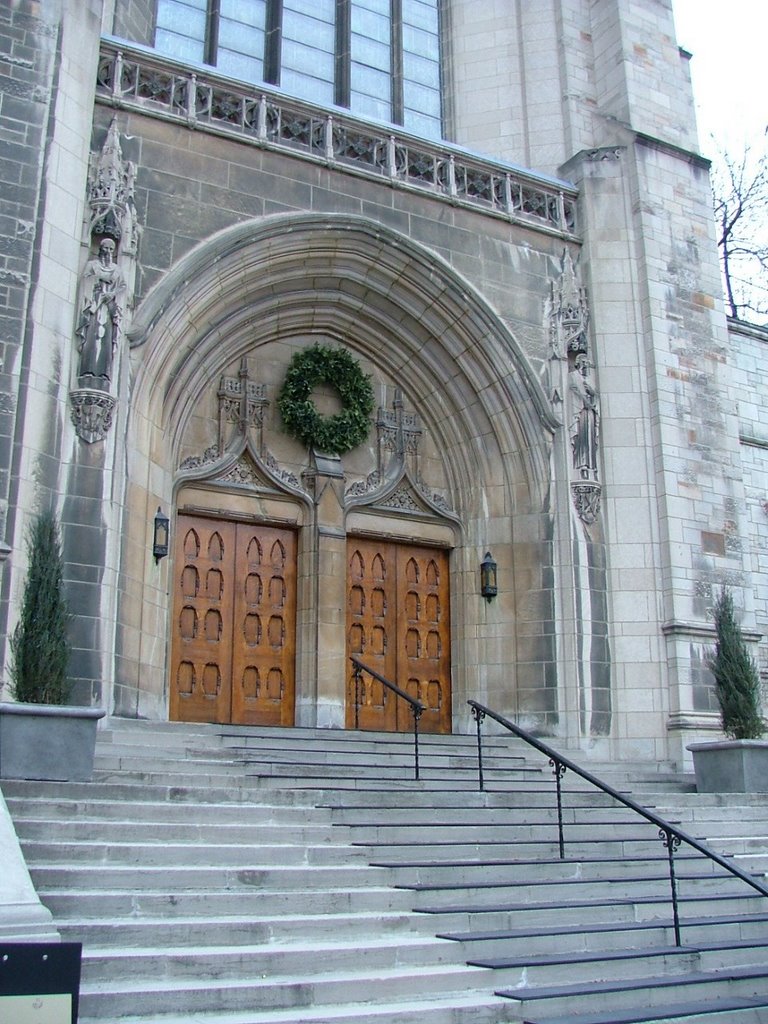


Last weekend Woolfoot was back in Montreal: the place where I spent almost all of my 20s, the place where I got my formal (and a lot if informal) education, the city of my heart. Unlike college days, however, on this trip, I also had two kids, and for part of the time, the husband in tow.
I was there for a meeting of the Vermont Bar Association. We were based out of the luxe Omni Hotel on Sherbrooke Street, in the heart of downtown. The formal bits of the meeting wrapped up on Saturday afternoon and then everyone got to do what they really came to do: have fun with their friends and family in Montreal. It also meant that the kids and I were still in town on Sunday morning. This rare event brought with it for me an undeniable sense that I was under a cosmic obligation to at least try to get the kids to the Church of St. Andrew and St. Paul, which is just stone’s throw (well, 4 blocks) from the Omni.
As the hart pants for streams . . .
The Church of St. Andrew and St. Paul is a Presbyterian Church and was built by a prosperous set of Scotch/English/Canadian high society back just before the second World War got going. It was an amalgamation of the Church of St. Andrew and the Church of St. Paul. This group (the founders of the “A&P,” as it is sometimes known) and their ilk have gone and we will not see their like again. In their current incarnation (today’s rich people), charitable efforts are not directed at church buildings and stained glass. The A&P, is a gothic revival stone church with an impressive stone tower that anchors the corner of Rue Redpath and Sherbrooke Street in what is still, in some senses, Montreal’s “best” neighborhood.
The sanctuary is large and long and the ceiling is vaulted. The pews, the altar, the pulpit, the model church over the pulpit, all are made well and out of the best things. It is a cathedral of and monument to a particular brand of colonial Britannic Protestantism. In the giant stained glass window over the altar Jesus rises triumphant and white with his arms outstretched and the awed onlookers include a be-kilted soldier holding a Union Jack. The weekly bulletins explain that the faded flags that hang in rows on slightly bowed poles above the heads of the congregation are the colors of the Black Watch, and that the church is the regimental church of the Black Watch.
I have never been particularly active in any church organizations but I grew up going with some regularity to the Methodist Church in my home town of Schenectady, New York. We may have made it to church about once a month. We were the family that was late every spring when they changed the clocks.
I bonded with those services and my fellow middle-Americans. In the ‘70s at our Methodist Church, everyone was nice and the emphasis was on reflection rather than fervency. The service went basically like this: Call to worship, hymn (choir entering), reading, children’s sermon, prayer (exit children), hymn, collection, sermon, hymn (choir exiting), blessing, cofffee, doughnuts. Once a month, on the first Sunday, we did communion, usually in our seats but sometimes at the rail. The hymns were the same ones my great grandmother sang.
Since then, this has seemed to me the right way for a church to be. As an undergraduate in Montreal in the mid-80s I was in search of a church in the poor man’s Paris that a Methodist girl from Schenectady could attend without making a fool of herself. McGill University, which is largely the product of that same group of people that endowed the city with St. Andrew and St. Paul, is in the same neighborhood as the Church. I decided to chance it. It was Presbyterian, but I figured that was close enough. Furthermore, I recalled that my maternal grandfather, Floyd Stark, had been raised as a Presbyterian by his mother, Ella Macumber, (though he had gone Methodist under Grandma’s influence) so I figured could claim some reasonable heritage connection.
We shall be changed . . .
It is one of the hazards of Protestantism that those born into any of its branches are likely at some point to go in search of church that speaks to them instead of simply submitting to the authority of their natal church. I respect the Catholic and Orthodox traditions, but 500 years of Protestant ancestry has disabled me from an honest embrace of them. I can’t help weighing up the belief systems on offer. At the Church of St. Andrew and St. Paul, I found my church.
The service followed the same outline as the Methodist one to which I had become accustomed. The hymns were the same, although the Presbyterians went in for something called metrical psalms. I loved the way they did things, though I couldn’t help a little bit of inner chuckling at the Presbers (church leaders) who periodically appeared, marching solemnly through the church and sat in the row of high backed carved gothic chairs at the back of the altar. They were not all older white men, there were plenty of women and people obviously not of Scottish heritage. They were all, however, so extremely dignified… The Church of St. Andrew and St. Paul still looks back to Old Scotland. I think the Queen Mother dedicated the Organ or something back in the 80s (I wasn’t at that service). I did hear a reading at the A&P one day by a very florid visiting gentleman named, believe it or not, Lord Elphinstone.
This is not to say that the church is snobby. There were quite a few students in the congregation with backpacks and casual clothes and I always felt quite at home there. I enjoyed these little cultural flourishes. They were so obviously not put-ons, but a genuine expression of the heritage of this Church. And the congregation was full of people of many stripes (the superintendent of the apartment building where I lived during law school, Mr. Ong, was a member of the A&P choir back in those days). People were exactly the right amount of friendly: they always smiled and nodded and said hello. The minister invited people to church events from the pulpit. No one tackled you to get your home phone number. Perfect. There were no guitars. No stopping the service midway to run around the church shaking hands and hugging.
The church has always had, and retains, a commitment to great church music. There is a professional music director and a choir that sings Christmas carols for the CBC each year. The massive organ can boom through the church to vibrate the stone pillars. Just as important, and what was such a treat, nay, blessing, for me on my recent revisit, is a minister with genuine literary talent. Back in the ‘80s and ‘90s when I went regularly to church at the A&P the leader was the Rev. James Armour. This last weekend when I was back in Montreal, the Rev. Armour, now retired, was filling in for whomever the new guy is. When I saw the Rev. Armour’s name on the sign in front of the church, I knew I couldn’t miss the service.
Q: Where have all the Rev. Armours gone? I studied English lit. as an under graduate and was marked forever by John Donne and John Milton and a handful of other religious geniuses who were also literary geniuses. The sermon is an art form, or can be. The Rev. Armour was clearly an offshoot of the root that is found way back in that tradition. I wouldn’t embarrass him by classing him with Donne and Milton but he could think, write, and deliver a sermon of beauty and logic week after week. More than just afflicting the comfortable and comforting the afflicted (the role expected of ministers, as he joked once) he mined the Bible for insight and gave sermons that demanded reflection. He did the same when I lucked back into church last week. I was so grateful to have a chance to hear him again this last weekend, I was almost overcome - which is not really the done thing there. Thank God – really, for all of it, and to all those Saints who from their labors rest who made the A&P what it is.
http://www.standrewstpaul.com/
Thursday, January 05, 2006
Jay Peak Update

Your cheerful hostess returns with a brief note for anyone out there interested in how things are going at Jay Peak in Jay, Vermont. (Way back in my first posts you can find more info.) I spent a big part of my recent five days off work in the woods there (only once on skis, more on that in a minute) and it was magical, as usual. Having seen the new Chronicles of Narnia movie a few weeks back, I kept thinking how a tall gas-lit street lamp would make a nice addition to my favorite walk.
The Christmas crowds were not too bad. Of course, I wasn't much on the slopes, which is what 100 out of 100 people come to Jay to experience. (The only person I met in the woods was the trail groomer and, one day, two cross country skiers). I did take one downhill run with my little girl (she has to wait for me at the bottom of the hill because she goes fast and I do not). I had just had my skis tuned and the snow was wet. I fell down twice and spent the few seconds when I was not falling down almost falling down. Even though I bought myself a pass for this winter, I have a feeling I am not going to be doing a lot of skiing. I have, however, come up with a possible solution to my failure as a skier. I have decided to blame my skis. It must be the skis, right? I'll rent a pair next time and let you know if I do any better.
Friday, December 30, 2005
Happy 2006
I had a passport photo taken today. It's a study in contrasts from the one taken of me at 29 (now I am standing on the brink of 41). Then I had a sharp jaw line and medium length blonde hair. Now I have two chins and medium length brown hair with strands of gray starting in. Then I was a young single serious girl witha serious romance. Now I am a broken down sour mouthed almost middle aged barely still married mother of two. Every one of those 12 years is showing these days. Motherhood and divorce lawyering and something of poor character have surfaced there. Well. It's a snap shot, right? And with the New Year one stops and reflects on what has been and what will be. I think in 2006 I am going to try to relax a little (the opposite of what you thought I would say, no doubt). This is not to say that I am giving up and going completely to the dogs. In fact, I think I am going to yank my foot out their slobbering mouths.
In 2006, I am just going to be myself and not worry so much. I have been editing myself and guarding my comments (believe it or not) for ages. I have also been guarded in getting to know new people. Well, why worry? Also, since I like to go out and walk and listen to music, I am going to do that more. It should help take off some of this shocking weight. I am also going to seek a path of self discipline based on self support instead of self loathing. How does that sound? Sounds good, like so much bromide. We'll see, Since I seem to be the only one reading this I might as well write something just for myself. If some other soul of goodwill has stumbled in here, best wishes to you to for 2006.
In 2006, I am just going to be myself and not worry so much. I have been editing myself and guarding my comments (believe it or not) for ages. I have also been guarded in getting to know new people. Well, why worry? Also, since I like to go out and walk and listen to music, I am going to do that more. It should help take off some of this shocking weight. I am also going to seek a path of self discipline based on self support instead of self loathing. How does that sound? Sounds good, like so much bromide. We'll see, Since I seem to be the only one reading this I might as well write something just for myself. If some other soul of goodwill has stumbled in here, best wishes to you to for 2006.
Sunday, December 11, 2005
More Regarding Gladys


There is a famous line in a famous hymn by Isaac Watts: "Time like an ever rolling stream bears all its sons away" (That's the line, the hymn is "A Mighty Fortress is Our God.") It occurs to me often, though not a very fashionable thought, and certainly when I consider what has become of Gladys. (Leave it to me, with however many generations of dour northern ancestry, to find the gloomy side of collecting old pictures and story books).
Gladys was famous in her day with the kind of fame that I think has a modern day parallel with Isaak Mizrahi or (at least once upon a time) Terence Conran. She was a brand. Her name appeared in large letters above the titles of the books she illutrated and sometimes wrote. In Gladys's 1977 obituatary, her friend, "the Hon. Lady Fisher," notes that in the 1930s it was "the in thing to wear a Peto dress." I think, however, given her times, her intelligence, and an innate dignity that comes through, she recognized the vanity of this. In the aforementioned interview in the Empire Annual For Australian Girls, she talks about how she continued to attend high society events, though bored to tears by them, to keep up her sketching skills. (see my post on Gladys Peto Proto Professional Woamn).
Gladys made her reputation during World War I by drawing caricatures and banners for the society magazine, The Sketch. (I will post a few of those when I can. They are among her best work.) The Sketch was a kind of cross between Town & Country and People Magazine. Gossip, or gossipy columns, reviews of popular plays, dewey photographs of the gentry with news of engagements etc. (Any academic with an interest in cultural history might find several thesis topics in The Sketch.) She also gained fame early on by illustrating the works of our own (American) Louisa May Alcott.
Her own writings came later, in the twenties and thirties, and mostly accompanied Children's books. Many of these she wrote herself (Gladys Peto's Children's Annual for instance made one or more appearances. The scholarship here remains to be done). Among my favorite of her early works is a compilation of stories and poems illustrated by her and written by her and several other bright lights of Great Britain the the 1920s, The China Cow.
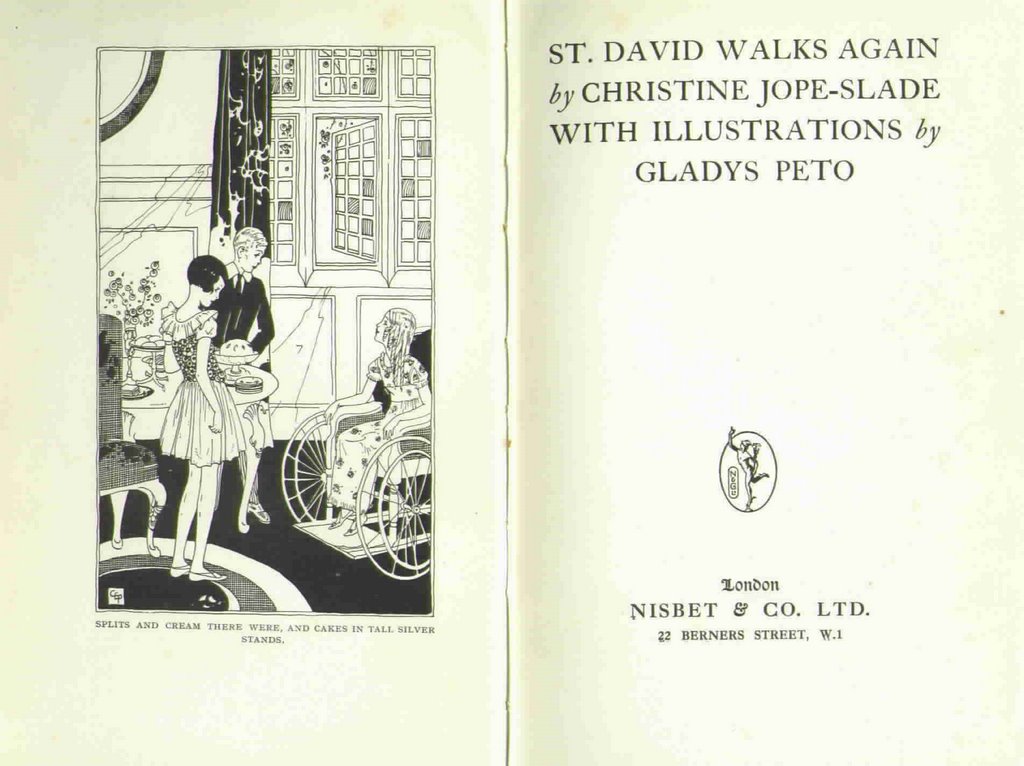
Among the contributors were the immortal Sewell Stokes, Christine Jope-Slade, Berta Ruck or C. Lindsay Emmerson (does that last name sound familiar?). While Virginia Woolf and H.G. Wells and other denizens of Gladys's world maintain a hold on our imaginations and some name recognition, the contributors to The China Cow have bubbled under that aforementioned ever-rolling stream. Berta Ruck was a famous novelist at the time The China Cow appeared. She wrote more than 100 books in her day and was married to another then famous writer, Oliver Onions.(Berta was also the brunt of a disparaging remark from Virginia Woolf in Mrs. Dalloway, and that is now one of her chief claims to fame). Christine Jope-Slade who wrote plays and screenplays during the 1920s and '30s including the unforgettable, The Mad Hatters and Britannia of Billingsgate . Sewell Stokes is an interesting figure. Knowing his association with Gladys I bought his memoirs, Personal Glimpses. In it, he confesses to having asked Gladys to marry him (he had contacted her about providing some artwork for his college (Cambridge somewhere) magazine. He beggared himself to take her to tea, commenting that she had the most beautiful hands in England. She politely declined his offer of marriage and he tried hard to forget her. A task made extremely difficult by the fact that Gladys Peto images stared down at him from every " 'bus and tube." (He referred specifically to the Allenbury's Food poster that appears in post card form on this blog.) Another aside, this is one of the really fun things about collecting, finding things like this. Stokes wrote many books, screenplays and plays, including a movie about Isadora Duncan. According to his memoirs (written when he was still a young man in the tone of a sarcastic undergraduate) Peto called him shortly after she refused him to tell him she was engaged. The man she accepted, Colonel C. Lindsay Emmerson, who, as noted, was also a contributor to The China Cow.
Next time I get an hour to myself, I'll tell you all more. I am sure there are legions of you out there panting to know more! (Did someone say "sarcastic undergraduate?")
Subscribe to:
Posts (Atom)